
Personality.exe
Filters, tools, presets, zines, and other fragments of the self to install.

Tuesday evening on Earth. Last letter before the summer break. Thank you for this year of exchanges, debates, and learning. You can read the archives.
Our digital personalities are forms of living matter coveted not only by artificial intelligence, but above all by other human beings. An executable computer file is not simply a document to be viewed. It contains a program that a machine can run. Opening it triggers a process, mobilises different resources, and produces an action within the system hosting it.
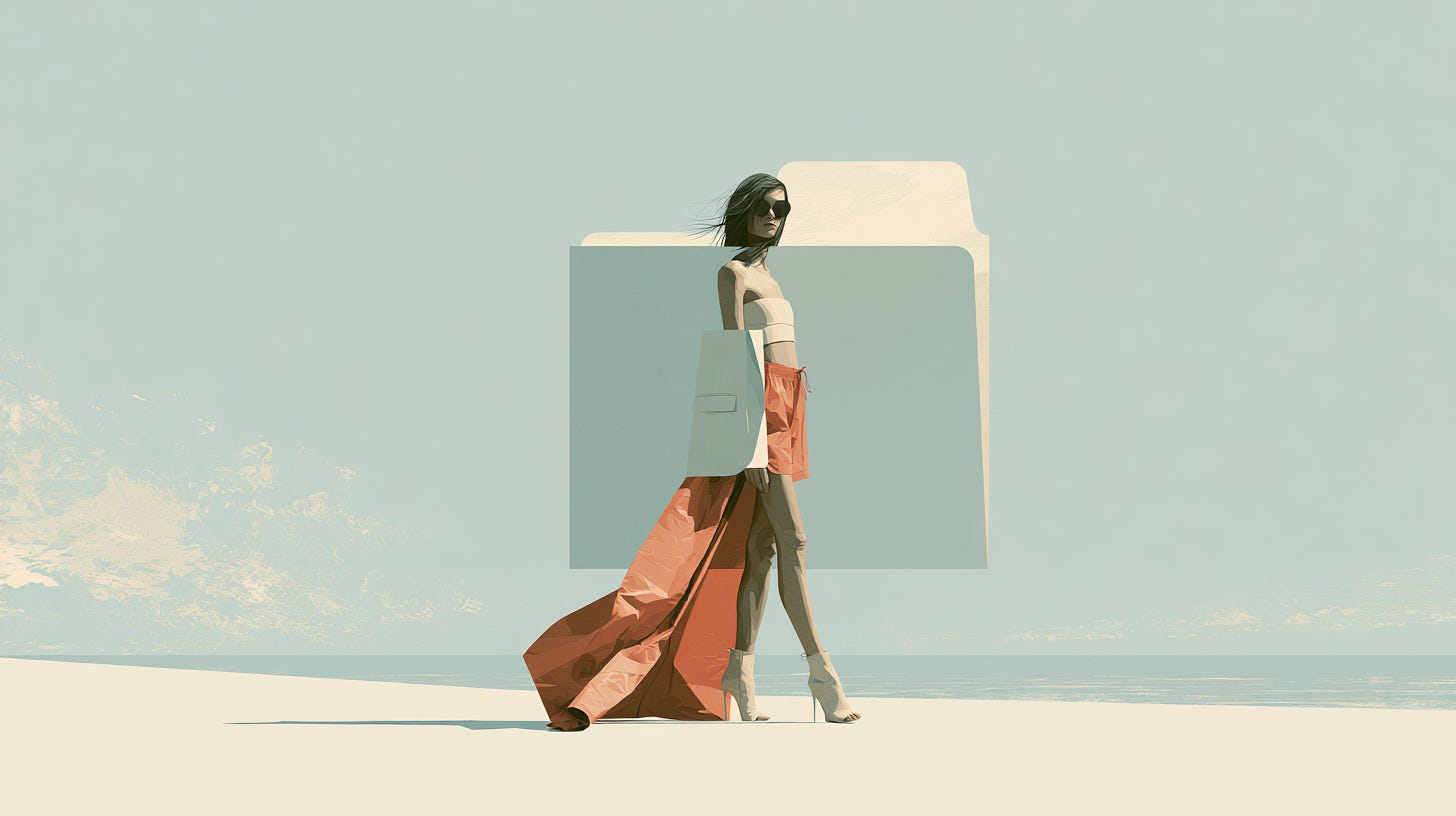
Our digital lives increasingly follow this logic. Our singular ways of perceiving, representing, and inhabiting the world are being compiled into filters, presets, templates, prompts, zines, and small objects. They are no longer merely displayed to an audience: they are made available for others to use.
Fragments of personality can therefore be distributed to other individuals and communities, who execute them within their own environments. They do not become exactly like us. But they can take photographs using our colours, organise their references according to our categories, adopt our expressions, or carry a small part of our lived experience with them.
Influence is therefore no longer simply about creating desire. It provides elements that can be installed.
To become executable, a personality must first be recognisable
On social media, the people who stand out very often possess an immediately identifiable aesthetic, narrative, or linguistic signature. Their imprint is stable enough for a colour, a phrase, or a particular type of framing to bring their alias to mind.
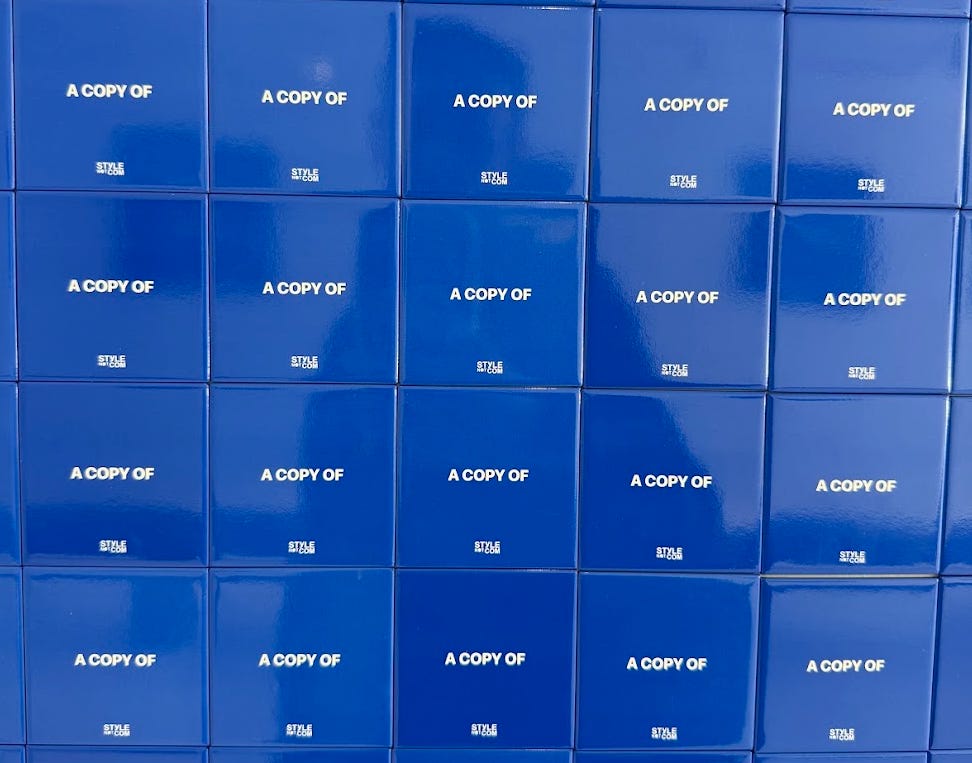
Beka Gvishiani, better known as Style Not Com, publishes fashion news and observations in the form of a few white words against a cobalt-blue background. This blue, partly inspired by Colette’s signature colour, has become inseparable from his perspective and his highly concise way of commenting on the industry. This visual grammar now extends beyond the feed. It has been translated into caps, collaborations, and physical spaces. In July 2026, Style Not Com turned its fifth anniversary into a Paris exhibition: an interface born on Instagram became an environment people could visit.
Charles Lopez, aka @vagabondiary, demonstrates that a distinctive vibe can remain powerful even when working with AI. His creative territory, encapsulated by the phrase Love in chaos, every day, relies on the repetition of certain motifs, framings, tensions, and emotions.
AI tools do not automatically produce this perspective. They make it possible to produce it on a different scale. What makes Vagabond Diary distinctive is therefore not each video taken separately, or even the technology used to generate it. It is the continuity of the prism through which the images are selected, reworked, arranged, and published.
Ultimately, Eugene Healey provides some relevant hypothesis: when asked in Paris what enabled him to achieve such a high level of online recognition for his ability to decode marketing and societal trends, the answer comes down to a single practice: operating his own timeline. Operating your own timeline means developing a small narrative operating system. A distinctive timeline is not merely a succession of recognisable pieces of content. It is the interface through which a person makes their perception of the world accessible to others—and almost something they come to expect.
Distributable fragments of personality
Albanian creator Flicka Elisa became an Instagram legend among photographers around the world more than ten years ago. As one of the first people to add subtitles to her photographs as though they were stills from a film, she created a distinctive universe, a sense of seriality, and a fictionalised version of her everyday life.
Her image treatment became immediately recognisable. Flicka Elisa therefore began selling her own Lightroom presets: settings files that allowed other people to reproduce part of the visual treatment she applied to her own Instagram account. Another user could download some of her settings, apply them to their own images, and make a fragment of Flicka Elisa’s perspective operate within their own everyday life.
To do so, she used Sellfy, a service launched in 2011 to allow creators to sell these kinds of digital products, subscriptions, or physical objects easily.
In an interview with Luisa Via Roma, she explained that her inspiration came less from a collection of external references than from her deep way of thinking about things and people:
“I become inspired by my deep way of thinking about things and people.”
Flicka Elisa
Her true product is therefore not simply a colour temperature or a contrast curve. It is a way of filtering reality, temporarily translated into technical settings.
Flicka Elisa does not merely make a file available. She produces personalityware: fragments of personality packaged as tools, objects, or formats that other people can activate within their own lives. This is not so far removed from the world of Tavi Gevinson and her zines. With Rookie, she did not simply inspire her community; she provided it with genuine identity-construction kits. Her publications were filled with collages, cultural selections, and DIY tutorials that functioned as raw fragments of her subjectivity. Her readers appropriated these material and conceptual elements and reassembled them within their own adolescence. It was the analogue predecessor of this logic: people adopted the Rookie aesthetic in order to “run” it within their own lives.
These creators no longer simply share their lives online. They transform them into small programs that other people can install within themselves.
An increasingly complex sign of belonging
These mechanisms first developed among digital professionals: photographers looking for presets they could apply directly in editing software, videographers downloading After Effects templates, and designers collecting fonts, textures, and graphic systems.
They have also existed within fandoms for a long time. Wallpapers, avatars, banners, GIFs, ringtones, and printable images already allowed people to import an idol into their digital environment. But the downloaded object primarily performed a representational function: it displayed the person or universe to which we felt attached.
The phenomenon is becoming more complex today. We no longer simply download an image of someone. We download something that enables us to see, make, or feel a little more like them.
At the same time, a form of charmification is emerging around these personalities. Fragments of lived experience sometimes leave the screen and become small fetishes to hang, wear, and keep close.
Model and author Nassia Matsa has just published a hybrid object somewhere between a bag charm and a photo book. Entitled Model check-in, the miniature book brings together photographs taken behind the scenes of her modelling career since 2017.
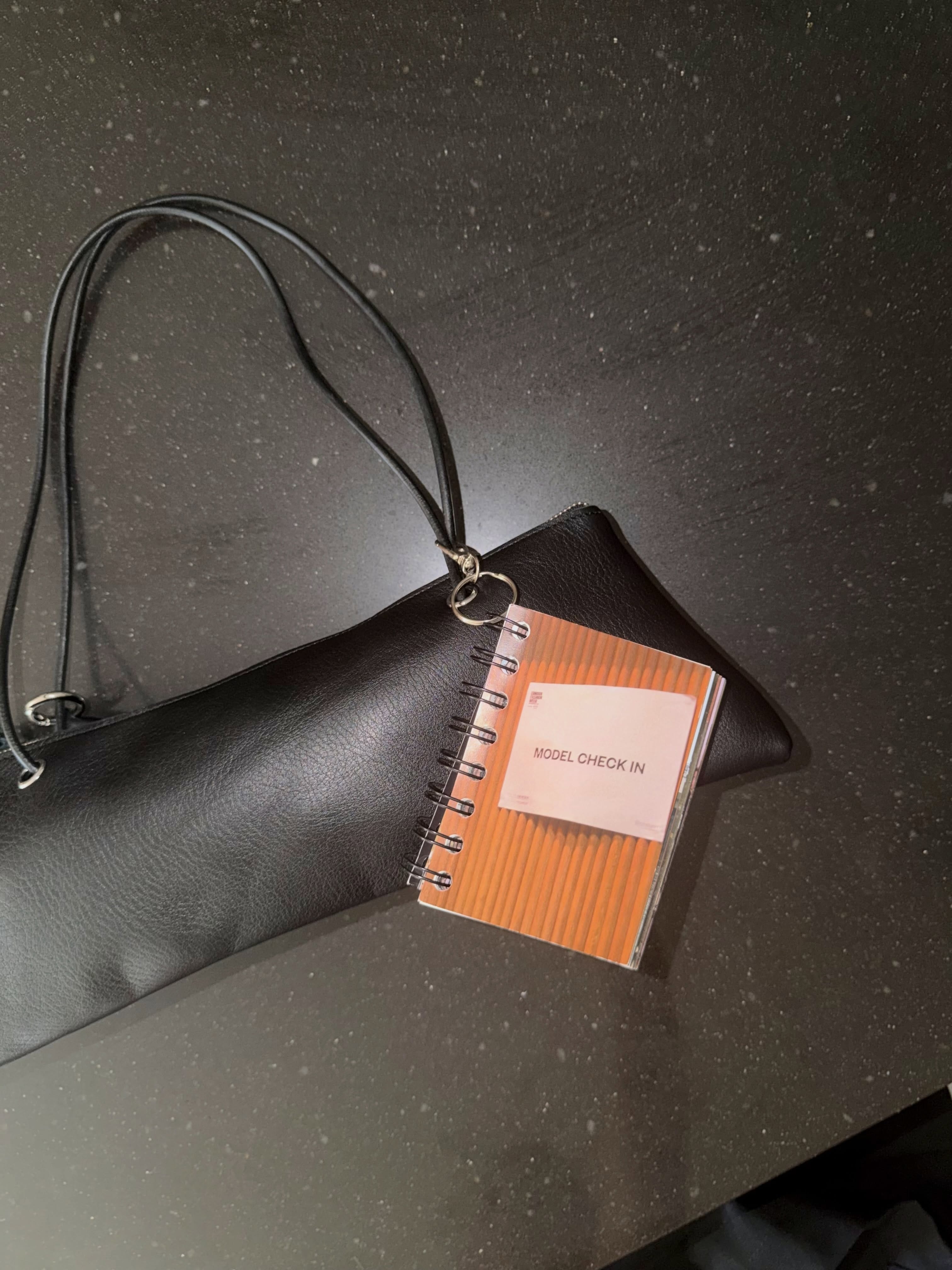
The project transforms the usually invisible side of modelling into a miniature, portable archive. It is no longer simply a matter of owning a product bearing the face or name of a personality. The object contains part of her perspective: what she saw from the inside, the moments she chose to preserve, and the way she tells the story of her own profession. You are no longer simply attaching your idol to your bag. You are carrying a fragment of her gaze with you.
From influence to interfluence
Here, personalityware becomes a sign of belonging, but also a vehicle for interinfluence - a term coined by Noemie Balmat. It allows people who share the same references to recognise one another, while introducing a small portion of somebody else’s world into their lives.
Interinfluence could describe precisely this circulation. Unlike vertical influence, in which a personality prescribes behaviours to an audience, it relies on a succession of appropriations, activations, and transformations.
An executable file does not produce its effects in a vacuum. It always operates within a particular system, with its own configuration, resources, and other programs. In the same way, a fragment of personality never produces a perfect clone. It encounters a person who is already constituted, combines with other influences, and generates a new variation.
We do not copy one another entirely. We execute small parts of one another.
If you’d like to support my work, feel free to forward this letter to someone who might enjoy it. Every new subscriber means a lot. You can also read me in French.
To go further:


The stat of the week:56%
According to BCG x Altagamma, 56% of aspirational luxury consumers do not know who the creative directors are at the Houses they buy from.
Amazing links
How to create a unique visual identity (Sublime)
The concrete sanctuary at Europe’s furthest fringe (FT)
To support this newsletter, please feel free to share, like, comment, or reply directly to this email. I love hearing from you!