
Digital Sediments
As the feed insatiably replaces our traces, we are looking for ways to give weight to our digital lives.

Tuesday evening on Earth. A letter written on my way to London; the perpetual back-and-forth of time and kilometres, while I keep my Charmera in my pocket.
We often talk about the consumption of online content when discussing our digital habits. And yet, this terminology is insufficient. Between endless scrolls and intrusive notifications, we are building our lives. Collective memories with friends; a conversation that feels like a moment of truth; the learning of who we are through what we allow others to feel. This is indeed a matter of liveness. A liveness which, paradoxically, is searching for its own gravity. Because when we live in spaces where a thunderbolt of love or a moment of grief can disappear under the weight of the next refresh or algorithmic reset, we begin to feel the vertigo of our own invisibility.
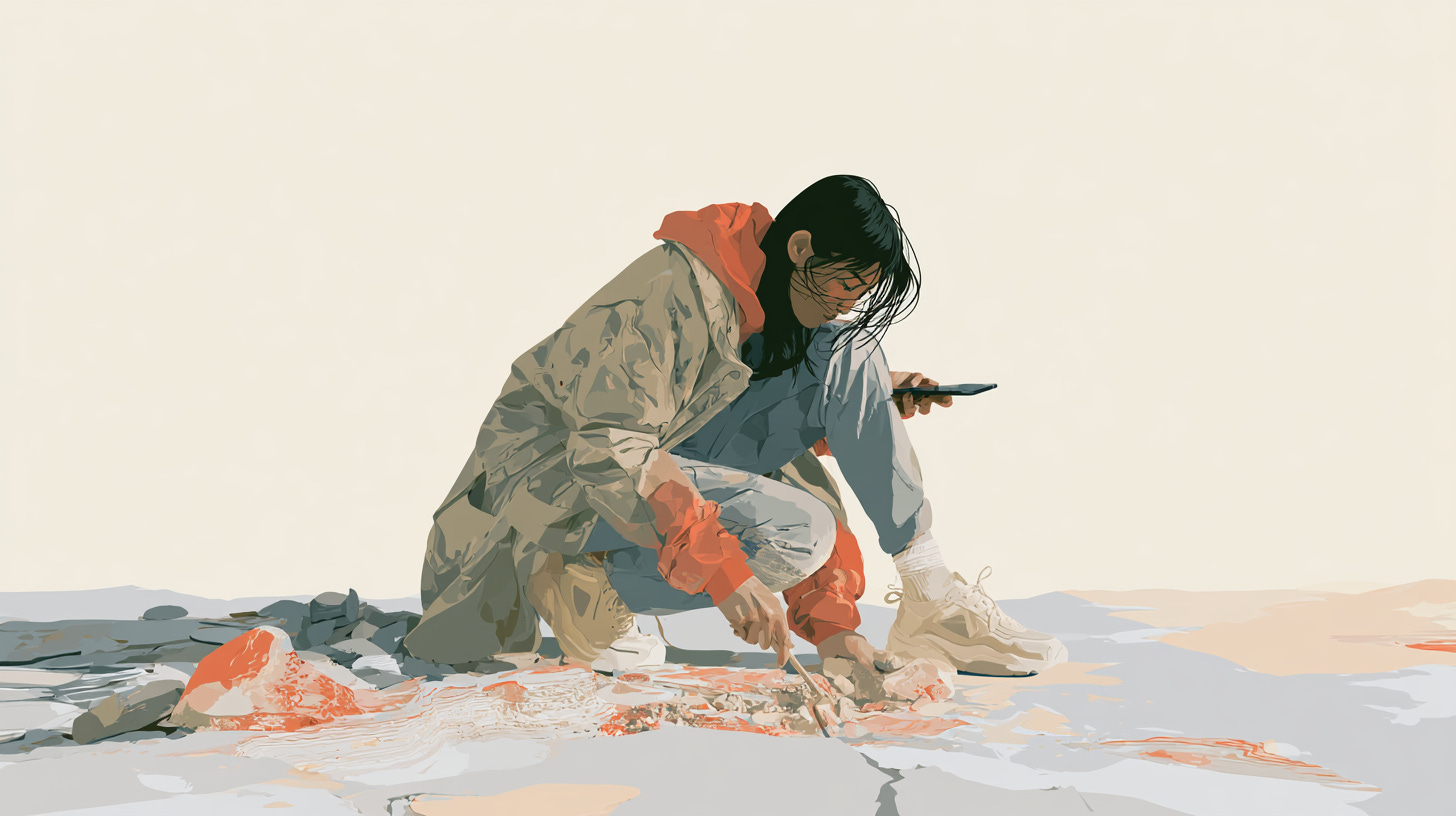
And this is probably why a deeper trend is emerging: the desire to move from a feed logic to genuine rituals of digital sedimentation, through the creation of tangible, lasting objects.
The craftsmanship of data
What we have been observing over the past year is a shift from a desire for digital keepsakes to a truly artisanal materialisation of our digital lives. The keepsake itself is nothing new: an object can freeze a memory in time, like a printed Instagram photo.
But it is becoming increasingly sophisticated. This materialisation is turning into a ritual: against the feed, humans are trying to organise their digital interactions by creating true sediments. Layers that accumulate on top of one another, thickening our personal stories. A craftsperson’s work, almost a goldsmith’s.
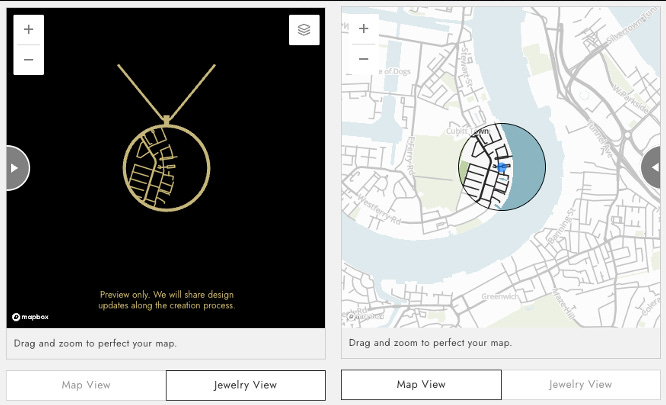
The work of artist Talia Sari consists in transforming an address that matters to someone into a unique piece of jewellery. Google Maps thus becomes a source of inspiration; instead of leaving a history abandoned, it is turned into an emotional vehicle that one can carry and pass on. People’s memories play a central role, as they co-create the object.
This desire for materiality is also exploding among digital creators. Ginevra Grigolo (@ginnijoie on Instagram) recently had her characters 3D-printed. This is not simply merchandising or goodies, but a need to bring figures out of the screen, to give them volume, a possibility of existing elsewhere than in the light of a monitor. As if the digital imagination, in order to become truly shareable, sometimes had to regain weight, texture, a cast shadow.
The digital rubs up against a saving friction; intimate data tears itself away from the flow to give life to a new form in a material. In China, for example, young people are turning the memes they use within their friend groups into actual seals. This ancestral technique, dating back more than 3,000 years, consists in carving a stone in order to engrave a drawing into it. And so Jack Ma’s facial expressions, WeChat icons, are transformed into stamps.
Faced with the programmed obsolescence of content left on our social networks, materialising one’s trace is no longer a gadget: it is an act of memorial resistance, a way of saying that we existed. This movement is interesting because it shifts our relationship to digital memory. For a long time, we believed that the web preserved everything. Hence the whole body of literature, notably legal, around the legitimate right to be forgotten. In reality, it preserves very badly: more than 38% of the web pages that existed in 2013 have disappeared, and we have little idea what will remain of our messaging exchanges.
The web archives without hierarchising, accumulates without ritualising, stores without necessarily giving value. Everything is vaguely there like an archived Story, a conversation from five years ago, but nothing really carries weight anymore. Digital sedimentation begins precisely there: at the moment when we no longer seek only to save a trace, but to give it a form. Ritual restores the word “fragment” to its original meaning: a more or less significant part of something, as opposed to the whole.
A digital world with weight
I like this idea from French historian and author Lennie Stern:
A dense present, where each interaction is added to the previous ones. Time looks less like a line than like a kind of layer that thickens as interactions accumulate.
Lennie Stern
She highlights the fact that the digital is made of interactions that do not immediately disappear behind the next ones, but are added to the previous ones, like a superposition of colours. For a long time, we thought of the digital in terms of the flow: something that passes, circulates, constantly renews itself. But our online lives look less and less like a clear line, and more and more like a stratification. Messages, images, places, avatars, private jokes, screenshots, playlists, memes, late-night conversations: none of this really disappears. It settles inside us.
There is something deeply contemporary here: a fatigue with digital lightness. We no longer only want our lives to be visible; we want them to leave an imprint. Not an imprint in the advertising sense, measurable in reach or impressions, but a sensitive imprint.
A way of saying, against algorithmic oblivion: we were here, together, and it mattered.
If you’d like to support my work, feel free to forward this letter to someone who might enjoy it. Every new subscriber means a lot. You can also read me in French.
To go further:


Expression of the week: discreet notoriety
“Discreet notoriety” is the theme of the next Séminaire des communicants de l’État, organised by the French Government Information Service.
An approach that invites us to rethink visibility in an age of information saturation. And I’m lucky enough to be presenting a few ideas there. Debrief probably coming in two weeks.
Amazing links
Trendscendence (Marian Park in Miscellanea)
‘You can be made a laughing stock to millions’: can gen Z escape the fear of being cringe? (The Guardian)
If you want to support me, feel free to share this newsletter, like, comment, or keep sending me emails: these notifications are a joy.
Well written, thank you :))